

Everyday Wellness Guides
5-Minute Comfort & Ease Cheat Sheet
5-Minute Comfort & Ease Cheat Sheet
Couldn't load pickup availability

5-Minute Comfort & Ease Cheat Sheet
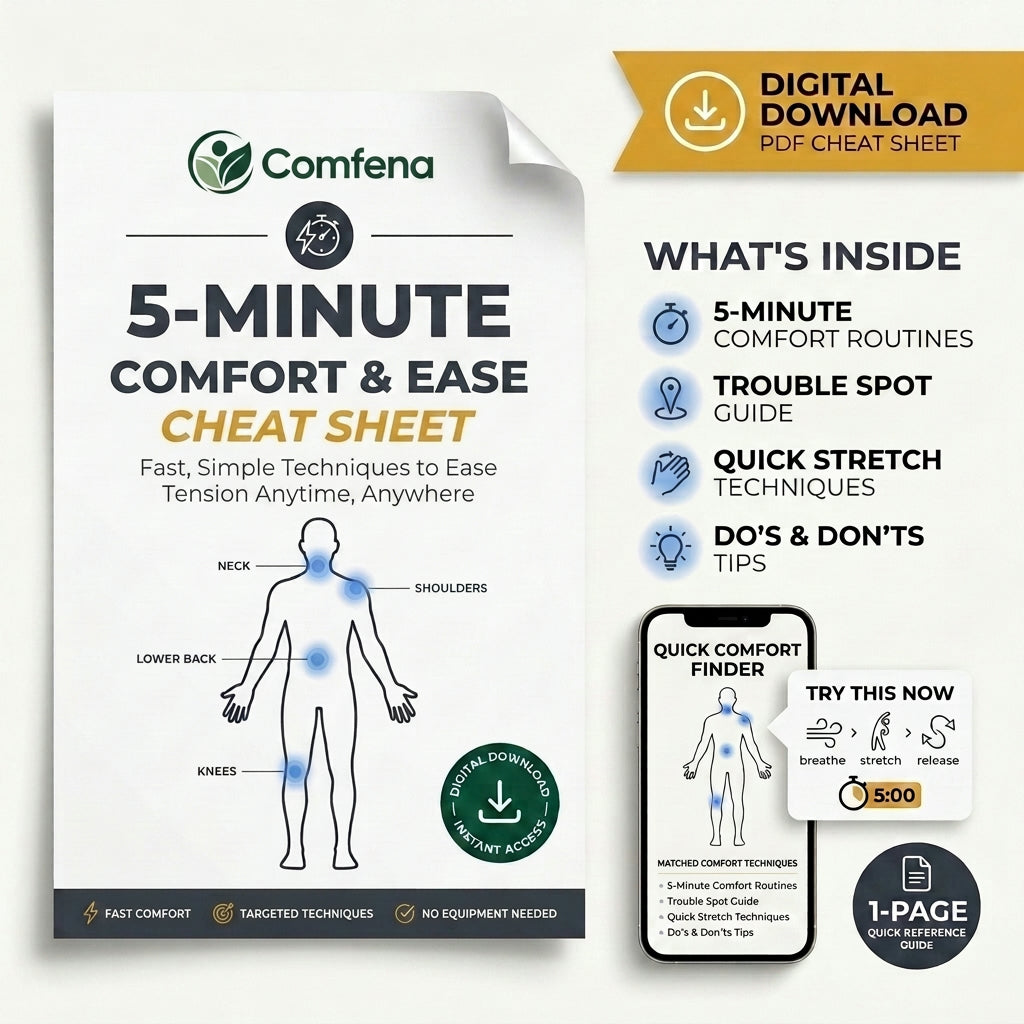
WHERE TENSION SHOWS UP
The four spots that tighten first
Screens and chairs load the body in the same few places. Here's what's actually happening at each one.
Neck
"Tech neck" from looking down at screens tightens the upper traps and the base of the skull.
Shoulders
Typing posture rounds the shoulders forward and pulls the shoulder blades out of position.
Lower back
Sitting shortens the hip flexors and flattens the natural curve in the lumbar spine.
Knees
Tight quads, hamstrings, and calves change how load moves through the knee joint.

HOW TO USE IT
Five minutes, matched to your day
Download the PDF
Your copy lands the moment checkout clears. No account to set up.
Pick your moment
Morning Wake-Up, Desk Break Reset, or Evening Wind-Down. Each is a different five moves for a different part of the day.
Or start from the trouble spot
If nothing's routine-shaped about your day, go straight to the diagram: neck, shoulders, lower back, or knees.
Follow the exact hold time
Every stretch lists its target area, duration, and how-to, so you're not guessing between 15 seconds and 30.
Check the Do's and Don'ts before you push further
Five habits that make the five minutes work, and five that turn a stretch into a strain.
Reading tips
How long
Five minutes, start to finish, for any one routine
How often
Every 60–90 minutes if you're using Desk Break Reset at a screen
Where to start
The trouble-spot guide, if you're not sure which routine fits
WHAT'S INSIDE
Four sections, laid out for a five-minute glance
Three built-in routines
Morning Wake-Up, Desk Break Reset, and Evening Wind-Down. Five moves each, no equipment.
A trouble-spot guide
Matched to four hot zones — neck, shoulders, lower back, knees — each with what's tightening and a one-line quick fix.
A six-move stretch table
Target area, exact duration, and how-to for each move, formatted as a single scannable table.
A Do's and Don'ts list
The five habits that make five minutes count, and the five that turn a stretch into a setback.
Also included:
A short line on when to stop and check with a professional instead — for injuries, chronic pain, or anything that doesn't ease with rest.

Read a sample
One trouble spot, straight from the page
No teaser copy — this is the actual quick fix for neck tension.
Chin tucks first, then slow rolls
Tech neck from screens tightens the upper traps and the base of the skull, so chasing the pain with a shoulder stretch usually misses it. The fix starts closer to the jaw: pull the chin straight back, hold five seconds, eight reps, then move into slow neck rolls in each direction once the tuck stops feeling tight.
Instant access
From checkout to first page in under a minute
Second 0
Checkout takes a card or wallet — no account to create.
Second 30
Receipt plus your permanent download link.
Minute 1
Open the PDF and read chapter one.
FAQ
Questions before you buy
How do I get it after buying?
A download link is emailed the moment payment clears. The link doesn't expire, so you can re-download it any time.
What format is it in?
A single-page PDF, sized to print on letter or A4, or to read on a phone or tablet.
Can I print it?
Yes — it's designed to hold up as a printed page taped near a desk or a mat.
Do I need any equipment?
No. Every move uses body weight, a chair, a doorway, or a wall.
Is this a substitute for professional care?
No. These are general comfort tips, not medical advice. If you have an injury, chronic pain, or a movement-affecting condition, check with a healthcare provider first, and stop if anything feels sharp or gets worse.
Five minutes from now, you could already be less stuck
One page, $1.04, yours to keep and print as many times as you need.
Add to Cart60-day money-back guarantee · Instant PDF download · Yours to keep forever